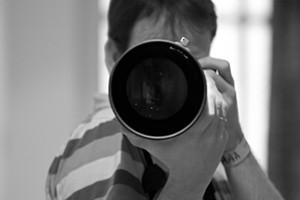
It’s been a little while since I had a Canon 5D Mark II in my hands. I’m very grateful to the good folks at Canon and at 1000Heads for loaning me such a wonderful beast to shoot the digital mission out at South by South West. When a gadget is “shiny new” it is hard to give an objective view of it, actually that is true for as long as you own any gadget. If you paid good money for something, you are always going to want to tell yourself it was good, aren’t you?
Well, the 5DII went back to its true home quite a while ago and since then I’ve been shooting with a 1Ds, a 40D and an old 5D (mark I). Now seems like a good time to reflect back on having the 5D Mark II and what I remember of going Full Frame and Becoming a Videographer.
The odd thing that really sticks in my mind was the battery life – it was brilliant. I normally have 2 or 3 batteries when I cover a long event. For the trip I had just one. In over a week of using the 5D it only got charged every other day, as I dived into my hotel room to change into evening clothes, then unplugged shortly after as I headed out. It didn’t get charged over night, as I only had one adaptor. Despite all that, it never even got close to having a low battery. Stunning.
Low light performance. This gets talked about a lot, and I mentioned it in my posts at the time, but it is a fact: the 5d Mark II seems to create light where there was none. I’ve used dozens of cameras from different manufacturers. Never experienced anything like it. With my love of night time photography and shooting events, it is a killer feature.
The size – it is not a full body – I’m playing with a 1Ds right now, boy is it a monster (and I love it in its own sweet way), but the 5D is big enough to get you into the press enclosure without being laughed out, and compact enough that you don’t end up looking like rambo.
The full frame sensor made my 70-200 IS f/2.8 L series lens a joy to use – a perfect zoom range for what I do. The 24-105 f/4.0 L IS lens I had on loan was a great walkabout lens, and ideal for shooting video (the image stabilisation a big plus).
I was stopped several times each day by people enquiring after the camera, “is that a Canon 5D Mark II?” Who knew there were so many camera geeks in the world! When I was shooting in New York a photographer brushed Julia to one side and started to ask questions about the video and image quality. It wasn’t so much Benjamin with a 5D Mark II, as the 5D Mark II with Benjamin. Anyway, my ego survived, and I got some great photographs to show for it.
There was just one thing holding me back from rushing out and buying one, and that was the lack of manual control in video mode. That’s now fixed in the latest firmware. Oh dear!
I’m finding this post more difficult to write than normal, so I’ll try and keep it short – as short as it can be, given the issues involved.
This is me, camera in hand, with its little SXSW press tag on. Videographer – Photographer it says on it. It does make me scratch my head and set one eyebrow lower than the other, quizzically. I wouldn’t really describe myself as a journalist. Yes, I’ve been paid to write articles for a publications, and taken photos that have too, but I’ve spent my career at the other end of the process, ‘creating’ news. Either way, my perspective on the whole process has altered dramatically over the last year or so, and that change was crystalized this last week.
I’m not, by any stretch of the imagination, an activist. However, I do care about the conditions we live under. There’s nothing especially noble about that, it just makes good logical sense. Living under oppressive conditions isn’t conducive to happiness.
Almost a year ago was the first WordCamp (there’s another one soon). It threw together a spectrum of people, from technical geeks to traditional newspaper editors. We discussed and argued about the differences between blogging and “the press” and how new technology is changing the process for everyone – a light bulb started to go on in my head. Then, a few months ago I sat and listened to Clay Shirky talking about the role of journalists in the local press holding local politicians to account. The light bulb went on a little brighter. Journalism, even just the act of recording things, creates accountability.
You might have heard about Peter Gabriel’s “witness” charity. Yes, that Peter Gabriel. “See it. Film it. Change it.” is the organisation’s slogan. It is an international human rights organization that provides training and support to local groups to use video in their human rights advocacy campaigns. You can listen to Peter Gabriel’s moving talk about his reasons for setting up Witness in this TED talk (warning: adult themes).
Earlier this year, a piece of legislation was passed in the UK, which makes it illegal to take a photograph of a police officer, military personnel or member of the intelligence services, which “may be of use for terrorism”. That’s a very vague definition, and open to interpretation by the police – who under Home Secretary guidelines can “restrict photography in public places”. The law is part of the Counter Terrorism Act. In these days of Google’s streetview, it is hard to see how this law really adds to our safety. What it does do, is to restrict our ability to be witnesses. That became all the more important in the last week. That light bulb I mentioned is now flashing, red.
Ian Tomlinson is now a name that should be familiar to you. He died during the G20 protests. The Guardian ran a piece on his death as did the BBC. The Guardian posted an update today, which mentions something called “Kettling” – something I’d not heard of it until the G20 protests. It is a strategy used by the police to contain the protesters, which consists of surrounding the crowd and then not letting anyone go. No arrests. Just detainment. But it wasn’t just protesters. A number of passers by were held, without any charges, and with no access to toilet facilities or water, for hours. Take a peek behind the media head-lines and read Roo’s account of what happened to him On the ground at the G20 protests. I met Roo at HomeCamp, trust me when I say he isn’t a trouble maker. You can read Steve Lawson’s account on his blog: G20 protests – a change is gonna come.
The fact is, everyone needs to be accountable. Us. The police. Our politicians. Photography and videography has an important part to play in that process. If your mobile phone has a camera or a video recorder, you can be a witness. If you do that in London right now, you could be detained or arrested. That’s not right. Local photographer Simon Taylor has lodged a petition on the Number 10 site. It has been mentioned in the British Journal of Photography and you can go directly to it here. As Roo says: This is why we need more photographers at public events.
A week in, and I’m convinced that the Canon 5D Mark II is a truly great camera – and I’ll post more about taking shots with it soon – However, it is the video capability that is getting a lot of buzz with users. You can hardly move about the interwebs without bumping into an amazing video shot with it.
It is a big thing moving from photography to video, but the 5D II has really opened my eyes to the posibilities. Traditional handycams just left me cold, and there was no way I could justify spending 10,000′s on a pro-video set up. But with the 5D you really can get great footage from day 1, and without the need for post-processing – important to me, because that is one of the things that makes video production so time consuming, I’m shooting events live and can’t spend days editing before getting things uploaded.
Entering the world of the videographer means understanding pulling focus, if you want cinematic shots, and thinking about movement as well as framing. It’s a big jump, but a fun one. Using the 5D is a very different experience than running about with a miniDV camera, there’s more to think about, but it is also a very rewarding experience.
While I was at South by South West Interactive I spotted Tim Vetter across the floor. He was shooting vox pops using the 5D Mark II and his unusual home made rig caught my attention. Here’s an interview I did with him, shot on the 5D of course, and uploaded in Blip.TV:
To my eye the video looks a little better in Vimeo, but there again, lots of people have told me that Vimeo doesn’t play on their machines.
Tim’s obviously thought about his set up a lot, and his DIY rig gave me some food for thought. Personally I’m more than happy with the built-in sound (I have a sound engineering background and I’ve mostly been using an external stereo condenser mic from my studio). Using the 50mm lens and the 24-105 f/4 lens with image stabilisation got me very good results during the show, even shooting hand held (JetBlue managed to loose my monopod on route – the joys of international travel)!
Excuse the Camera geekery, but I know that this will be interesting to my DSLR friends, because everyone keeps asking. So, remember that I currently have a Canon 5D Mark II in Hand. It is has a full frame sensor. That’s a big deal to Digital SLR buffs. Most of the budget and semi-pro models have what’s called a cropped frame sensor. That basically means that the piece of electrickery where the light lands aren’t the same size as the traditional 35mm film. There are various reasons for that, but the main one really is cost. Building a big (full frame) sensor is more complex and costly than building a cropped frame one. First, some shots with the 5D Mark II from New York (best viewed in full screen)….
So, back to cropped frame sensors. A couple of things happen:
Not all the light from the lens gets though.
The focal length is scaled up.
The first means that not all of the light coming into the lens gets used (as some of it spills outside of the area of the frame). Canon turns this to their advantage by making some more affordable (and lighter lenses) – the EF-S lenses. It also means that you get less vignetting, since the edges of the lens, where you get light fall off that causes the darkening of the corners, don’t get used.
The second feature means that everything ends up a “zoomed in”. If, like me, you’ve never used a 35mm camera or a full frame camera, then you probably won’t notice. It does mean that some of the photography tips might be a bit off (a 50mm lens acts a lot more like an 85mm lens, so you have to ‘adjust’ accordingly). For 35mm traditionalists, it drives them a bit mad. For the rest of us, it means a smaller lens will get us closer to the subject than with a full-frame.
There is a lot of snobbery about frame sizes. The purists view full frame sensors as the only ‘true’ cameras, and point to lower noise and better light sensitivity for the big SLR beasts. That’s not always going to be the case, given the different generations of technology. These days there are bigger things at play.
So, how is full frame land for me? I have to say, I’m loving it. People have asked how it is loosing the ability to really zoom in tight on a subject. Answer? Wonderful. Why? Because all my lenses are wider – I can get more into the frame and stand closer to the subjects. If I want to get a longer lens, I have an EF 2x extender, which turns my 70-200 lens into a monstrous 140-400mm. The high ISO of the 5D Mark II means that it is more than fast enough to make up for the couple of stops of light I loose in using the extender. I’m using my 85mm for portraits, rather than my 50mm – which is now much more useful for capturing the scene. The 70-200mm L-series lens I have was too tight, now it is getting a lot more use.
Using the 5D Mark II, it feels like it is much more sensitive to light than my 40D, even at the same ISO settings. I’m putting that down to the full frame size. The 5D also has a “peripheral illumination correction” setting, which is a very grand way of saying that it reads what lens you are using, then digitally corrects for the vignetting. Personally, I like a bit of edge fall off – it adds some interest to conference shots, which can otherwise be a bit bland – so I’ve switched the feature off. However, it is very useful to have it there, and it works very effectively (it is calibrated specifically for each lens).
As I mentioned before, I’m loving the feeling of a larger viewfinder too. As you can probably tell, I’m very sold on full frame photography. Not for the technical specs (although I am blown away by the 5D Mark II’s image quality – as it everyone who sees the shots), but because suddenly my lenses feel right. That makes sense, as they are EF lens (designed for full frame use). Moving up to a 5D means leaving the EF-S lenses behind – actually, I have them on the back up body I have with me. I can’t say that I’ll miss them though. Oh, and do I miss the flash? With the 5D’s sensitivity, I don’t think so!
This is what I’ll be using to photograph the Digital Mission to South by South West. A HUGE thank you to the folks at 1000Heads and Canon for getting this beast into my hands in time for the trip. Getting hold of an EOS 5D Mark II is like getting hold of gold dust, so I really am very grateful!
Initial impressions of the 5D Mark II? Well, the body. Very sturdy – and looks all the better for not having a pop-up flash (my 550EX flash will be coming along to Texas). Putting a lens on and firing it up took my breath away. I’m of the generation that started with a Digital SLR – I’ve never used 35mm film. So, forget the technical arguments about full frame cameras versus cropped frame for a minute, and imagine the difference between looking out at the world through a port-hole and looking out at it through French windows. That’s the best description I can think of.
Pretty much everyone who has seen the camera today has asked about it – even when I was on the train in to London. Lots of interesting conversations. I’m really pleased with the shots I got this afternoon – I’m looking forward to some good subjects. Anyway, I better go and get some clothes packed for this trip, or I’ll just be wearing the camera… In the meantime, here’s what one of my sons says about it (filmed on the 5D of course):
That’s shot handheld with an 85mm lens, and transcoded (recompressed) by Vimeo to host it… There will be much more in my flickr stream and the digital mission blog as the week goes on. South by South West here I come…
One of the secrets to getting good at photography is to carry your camera everywhere, and that’s pretty much what I do. However, there are times where lugging around my trusty red rucksack with a full Digital SLR, a couple of lenses and a flash, just isn’t practical.
Then there’s the impact of whipping out a full sized SLR camera with a big lens. Seriously, last week at an event I pulled out my camera to take a picture of the speaker (I’d asked his permission before he started talking). I would probably have caused less disruption if I had drawn out a firearm and waved it about whilst shooting at the ceiling. Some people are nervous of cameras, and REALLY nervous of BIG cameras. Sometimes, small is good.
So, back to that Canon PowerShot SX200 IS. I ignored it at first, even though it was shiny-new-not-even-available-in-the-shops-yet. I was distracted by the small, sexy IXUS 100 IS - there was even a red one, what did you expect me to do?
Then I picked up the Powershot. I looked at the screen, which felt strangely like looking through the view finder of my DSLR. It is big, clear and fast. Then I fiddled with the very familiar dial on top and set it to Aperture priority mode. Ooo… Nice… Then I took a couple of shots. Ooo… Really nice.
It has got a 12 X optical zoom (equivalent to a 28-336 mm lens on a full frame camera, which is about the range I carry in the lens set with me when I’m using my DSLR). The sensor is 12 Megapixel with ISO up to 1600, and Canon’s DIGIC 4 chipset handling the image processing.
You can put the Powershot into auto mode and use it as a (very clever) point and click – it has face detection and scene detection with really good image stability – or you can twist the dial and go all Tv/Av/M and make like you have your DSLR with you, tweaking the settings to your heart’s content. The aperture is wide for a compact camera, so you can even get shall depth of field for arty portrait shots.
Here’s the clincher for me: it supports 720p HD Movie recording, complete with an HDMI output ready to plug into an HD screen. Something my current DSLR won’t do! This thing is ideal as a complement to my full bodied DSLR when I want something I can just slip in to my pocket. Very neat. It is also a nice step up for someone moving from the point and click world towards a full on digital SLR. I’ll be recommending it to a few folks.