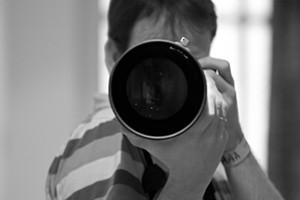
Benjamin Ellis

Benjamin – Not Ben – Jamin on the Net

Going to a Full Frame DSLR Camera

Excuse the Camera geekery, but I know that this will be interesting to my DSLR friends, because everyone keeps asking. So, remember that I currently have a Canon 5D Mark II in Hand. It is has a full frame sensor. That’s a big deal to Digital SLR buffs. Most of the budget and semi-pro models have what’s called a cropped frame sensor. That basically means that the piece of electrickery where the light lands aren’t the same size as the traditional 35mm film. There are various reasons for that, but the main one really is cost. Building a big (full frame) sensor is more complex and costly than building a cropped frame one. First, some shots with the 5D Mark II from New York (best viewed in full screen)….

So, back to cropped frame sensors. A couple of things happen:

  • Not all the light from the lens gets though.
  • The focal length is scaled up.

The first means that not all of the light coming into the lens gets used (as some of it spills outside of the area of the frame). Canon turns this to their advantage by making some more affordable (and lighter lenses) – the EF-S lenses. It also means that you get less vignetting, since the edges of the lens, where you get light fall off that causes the darkening of the corners, don’t get used.

The second feature means that everything ends up a “zoomed in”. If, like me, you’ve never used a 35mm camera or a full frame camera, then you probably won’t notice. It does mean that some of the photography tips might be a bit off (a 50mm lens acts a lot more like an 85mm lens, so you have to ‘adjust’ accordingly). For 35mm traditionalists, it drives them a bit mad. For the rest of us, it means a smaller lens will get us closer to the subject than with a full-frame.

There is a lot of snobbery about frame sizes. The purists view full frame sensors as the only ‘true’ cameras, and point to lower noise and better light sensitivity for the big SLR beasts. That’s not always going to be the case, given the different generations of technology. These days there are bigger things at play.

So, how is full frame land for me? I have to say, I’m loving it. People have asked how it is loosing the ability to really zoom in tight on a subject. Answer? Wonderful. Why? Because all my lenses are wider – I can get more into the frame and stand closer to the subjects. If I want to get a longer lens, I have an EF 2x extender, which turns my 70-200 lens into a monstrous 140-400mm. The high ISO of the 5D Mark II means that it is more than fast enough to make up for the couple of stops of light I loose in using the extender. I’m using my 85mm for portraits, rather than my 50mm – which is now much more useful for capturing the scene. The 70-200mm L-series lens I have was too tight, now it is getting a lot more use.

Using the 5D Mark II, it feels like it is much more sensitive to light than my 40D, even at the same ISO settings. I’m putting that down to the full frame size. The 5D also has a “peripheral illumination correction” setting, which is a very grand way of saying that it reads what lens you are using, then digitally corrects for the vignetting. Personally, I like a bit of edge fall off – it adds some interest to conference shots, which can otherwise be a bit bland – so I’ve switched the feature off. However, it is very useful to have it there, and it works very effectively (it is calibrated specifically for each lens).

As I mentioned before, I’m loving the feeling of a larger viewfinder too. As you can probably tell, I’m very sold on full frame photography. Not for the technical specs (although I am blown away by the 5D Mark II’s image quality – as it everyone who sees the shots), but because suddenly my lenses feel right. That makes sense, as they are EF lens (designed for full frame use). Moving up to a 5D means leaving the EF-S lenses behind – actually, I have them on the back up body I have with me. I can’t say that I’ll miss them though. Oh, and do I miss the flash? With the 5D’s sensitivity, I don’t think so!

If you're new here, you might want to subscribe to the RSS feed. Thank you for visiting and do pop back!

Posted 12 months ago at 12:54 am. 6 comments

Holding the Camera

This is a nice tip for holding the camera. It works best if you are left-eyed and using a tall-bodied camera, like a motor wound 35mm or a DSLR with a battery grip. It comes from Joe McNally – a successful US photographer.

Embedded Video

Tags:

Posted 1 year, 4 months ago at 5:40 pm. Add a comment

London Solo Bass Night

A very nice evening yesterday, seeing Steve Lawson, Yolanda Charles and Todd Johnson in concert at Darbucka, which turns out to be a rather special little venue in NE London. Not great for photography, as it is very dark, but a nice atmosphere, great food and there was enough mobile coverage to do a little bit of twittering.

There’s a fuller write up on the Bass Blog here.

Posted 2 years ago at 7:44 pm. Add a comment

Going All Visual – London at Night

Every so often I like to do something different for a change. Learning new skills and meeting new people keeps you young and flexible. With that in mind, I signed up to a meeting of London Flickr folks, to do an overnight photo walk in London. As a result, I met a great bunch of new people (thank you to you!), picked up some photography tips and took some great (I am told) photos:

St. Paul’s by Night by Benjamin EllisView over the Millenium Bridge - by Benjamin EllisOn the OXO peir - by Benjamin EllisMillenium Bridge and St. Paul’s - By Benjamin Ellis
Just click on any of them to see the larger version. If you really like them, I have them as RAW and very high resolution JPEGs. My feet were sore when I returned, but I discovered more of London and the value of a tripod (some of the photos are VERY long exposures)!

Posted 2 years, 2 months ago at 9:36 pm. Add a comment