
I didn’t expect to go to an AI event and come away thinking about an invention from the 1440’s, and the Bible, but that is exactly what happened last week.
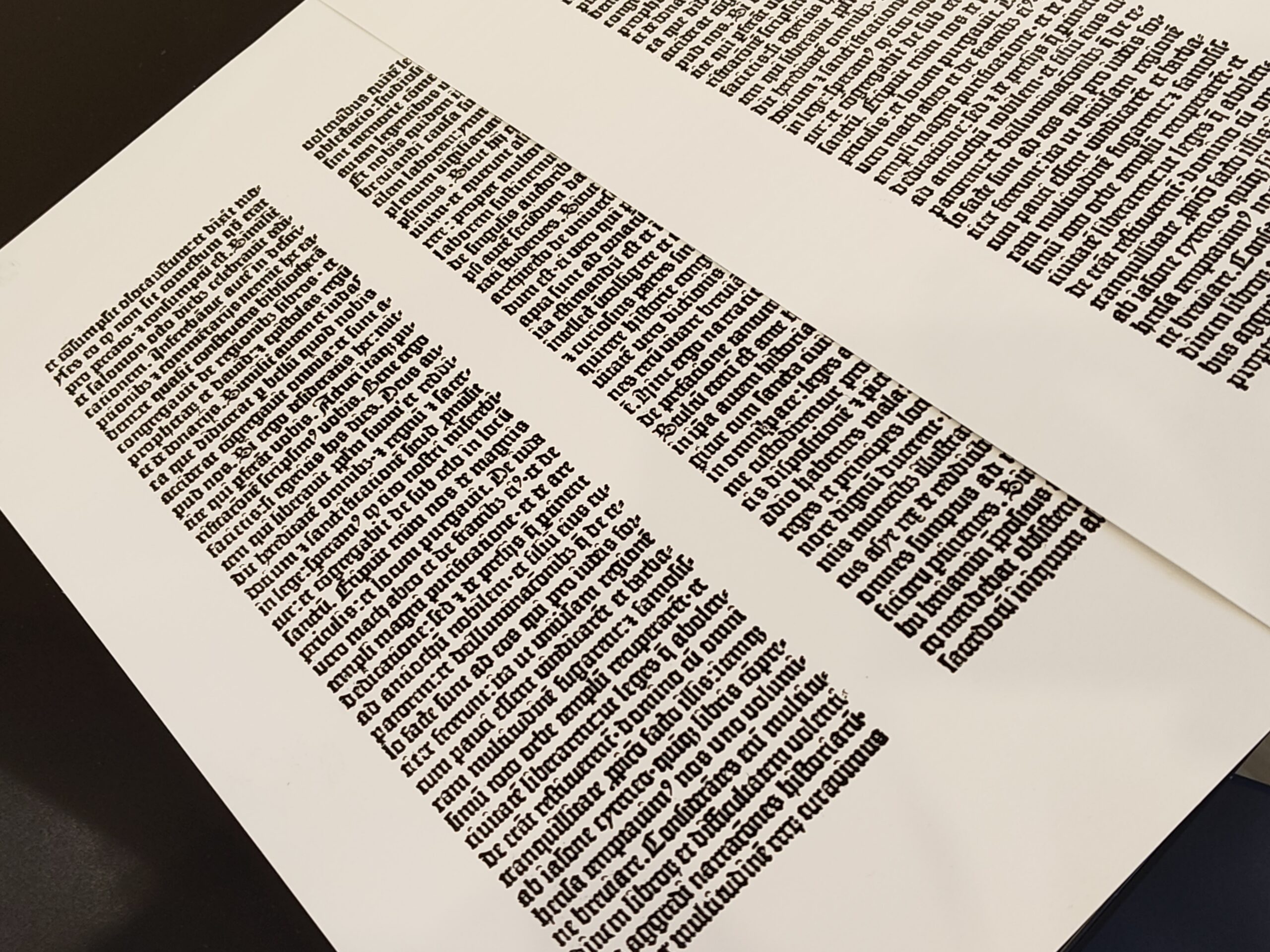
At the Reading 100 AI Summit, run by Thames Valley AI Hub (TVAI), it was seeing the Gutenberg press that has stayed with me most. Not some replica hidden in a glass case, but a working recreation, used in the documentary with Stephen Fry “The Machine That Made Us”, with someone showing how it worked, and talking about its impact. It reminded me of my first visit to Bletchley Park in some ways. It turned knowledge into a lived experience. Whether AI turns out to be the kind of shift the printing press was, only time will tell. The parallels are hard to ignore, though.
Some of the details gave me pause for thought. Gutenberg cast his letter ‘e’ in several widths so that his lines could be adjusted to align like a hand-copied manuscript, justified edge to edge. There is an often repeated pattern there: The first version of a new technology usually mimics the paradigm it is replacing. That limits it until it breaks free from them. I think we are watching that happen again with AI, as it gets bolted onto existing workflows. That isn’t what it does best.
The concerns are familiar too. Printing was going to destroy language. AI, so far, mostly regurgitates material that already exists, but it also corrupts it. The ‘AI slop’ problem is a real and present menace, and came up many times during the day. I picked up several new terms for it over the day, none of which I will use in polite company here. The serious point underneath the jokes is that people are passing off uncritical AI output as finished work, and that is causing real problems for many organisations. The provenance of information is unmanaged, unaccounted for and an existential risk.
There were three main things I took away from the day:
- Automation removes the low-cognitive tasks that used to give people a warm-up and a breather between hard decisions. What is left is continuous, high-stakes decision-making with no mental recovery. I have made this point many times before, and the discussion of eroding critical thinking when the lightweight lifting is offloaded is an additional impact.
- Stuart Fenton, Reading FC’s Head of AI, gave a compelling overview of what the club is doing with AI. He made the point that in a data rich environment too many numbers brings confusion, not clarity. Data has to be distilled down to a small number of metrics, each with a direct line of sight to the strategic goals, otherwise nobody acts on it. You can overwhelm a leadership team with dashboards and AI-generated research. None of this is new; but it is often forgotten when a project has AI in the title. People expect lots of data, but that doesn’t mean that they want or need it.
- Models trained with human feedback are very prone to sycophancy, so they reinforce existing views rather than challenge them. If you are an expert, start with what you know, then bring the AI in second, and always debate its output. Businesses need to be more like a courtroom – today they tolerate a loose definition of ‘fact’. The evidential approach used in a legal setting exposes just how little grounding most AI-generated content actually has.
The thread running through all of it is that working with AI needs well designed decision-making flows, because there are so many more decisions to make and review than before. The design has to guard against cognitive surrender – the ‘giving up and letting AI decide’ – when actually deeper thinking and better evidence gathering is required. The facts are becoming harder to find, when we had expected they would be easier to get. AI might not be a new Gutenberg press, it could just be an acceleration of many of the same effects.
Thank you to the organisers and speakers. Event details, for anyone curious: https://tvaisummit.com/reading100ai/